Showing posts with label drawing. Show all posts

Thursday, December 8, 2022

O Glorious Lady, Throned In Rest


 'O glorious Lady, throned in rest, amid the starry host above, who offered nurture from your breast to God, with pure maternal love.'

This the first stanza of a hymn text by the 19th century English divine, John Mason Neale, an Anglican scholar and hymnographer and contemporary of Saint John Henry Newman.  Like Newman, Neale was part of the Oxford movement and had a particular devotion to the Blessed Virgin Mary.  Unlike Newman, in the end, Neale never undertook the ultimate step of becoming a Roman Catholic.  

In Morning Prayer this morning for the Solemnity of the Immaculate Conception - a Marian dogma confirmed by another contemporary of Neale's, Pope Pius IX in 1854 - I came across this beautiful hymn to the Blessed Mother, entitled: "O Glorious Lady Throned in Rest" sung by Kathleen Lindquist in an album entitled : "Hymns and Chants of the Divine Office, Vol.1"

All of which coincides nicely with the Virgo Lactans or Nursing Mother of God icon* I've started working on as a way of meditating on the mystery of the Incarnation during Advent and Christmas.  How Mary could give birth to God, much less nourish and nurture her Creator from her own body is a lot to reflect on, which I do better with a brush in my hand. 

*In the Christian East icons of this type had the title of Galaktotrophousa in Greek and Mlekopitatelnitza in Slavonic. 


Friday, September 30, 2022

Paint Bigger


 One of the ironies of growing older as an artist is this: as one finally has more available time to devote to art, one's capacity inexorably diminishes with age.  In my case, I've noticed that its gotten harder and harder to focus on smallish details in a drawing or painting. 

Hence the visor, complete with interchangeable lenses and headlamp that I find necessary whenever painting most icons nowadays. 

It's really just a minor inconvenience (at least in the studio I don't have to wear a facemark- another minor inconvenience).   I'm grateful too that my hands continue to remain steady (if I don't drink too much tea!)  and with sufficient light and the additional magnification, I'm able to see well enough to continue drawing and painting. 

I'm reminded of my visit in 1985 to Holy Trinity Monastery in Jordanville, New York where I met the master iconographer Fr. Kyprian, who at that time was in his 90's.  He was in his studio up on a high ladder working an enormous icon of the Mother of God and Jesus, wearing a paint-splattered apron and a pair of glasses with thick lenses.  

When we were introduced, he graciously welcomed me, noticing that I was somewhat astounded by someone as old and frail as he was clambering up and down a tall ladder.  Nodding towards the ladder and the mural sized icon behind him, he laughed and made the comment that as his eyesight worsened, his solution was to simply paint bigger. 

Not a bad approach to age and art. 


Tuesday, October 25, 2016

The Brilliance of Eternal Values

"By using [the perspective of importance], Byzantine painting accentuated the holiness of the persons represented.  Their individual and temporal aspects were thus clothed by the brilliance of eternal values, and the image itself receives a function other than that of a simple drawing.

The way that an icon grasps, understands, and draws its subject cannot be based just on physical vision but must be interpreted by thought.  In the same way, its optical effect undergoes a change; by enlarging the proportions, the main person seems to move out from the interior of the icon toward the spectator.  The focus is thus inversed.
Pere Egon Sendler SJ. 'The Icon: Image of the Invisible


For an iconpainter, the representational conventions of Byzantine painting are so familiar  that it is easy (at least for me) to lose sight of how peculiar those conventions are that depict the human form in space.   I've been sketching out the cartoon for an icon of St. Anne, with her daughter, Mary, the Mother of God and Mary's son, Jesus.  I first encountered this image of mother, daughter and son in the work of my teacher, Pere Igor (Egon) Sendler, in the photograph of a fresco he painted in the 1980's.  As in many icons, Mary is depicted both as the Mother of God (that is to say, as an adult woman with her son, Jesus), and as the youthful daughter of St. Anne, symbolized by her diminutive stature in comparison with her mother.  

Which is a reminder for me of two things.  First, that drawing is always a way of seeing and thinking about the visible and invisible realities that we seek to perceive, comprehend and depict.  Second, that when it comes to what Pere Igor speaks of as those realities that are "clothed by the brilliance of eternal values", our ordinary, natural ways of sight and perception are inadequate to fully represent the subtle and elusive mystery of a world tranfigured by divine Grace.  Paradoxically, the more painstaking the attempt to enclose such realities in the garb of naturalistic realism, their luminous brilliance simply fades from sight.  


Monday, October 3, 2016

Getting to the Start Line


l
I love to draw but its a steep climb getting to the start line.   For me, at least, despite years of experience drawing, I still need to get through the "preparatory rites" before putting pencil to paper.  Today, I took the entire day off,  ready and eager to draw.  Which I did, but only after praying, reading, three cups of tea, doing two loads of laundry, straightening up the living room, taking out the trash, sweeping the floors and putting clean sheets on the bed.  Pondering throughout the icon cartoon I intended to draw but it was early afternoon when I was actually at the drawing, ready to begin.

I've learned over the years that what I first considered procrastination is in reality an oblique way of getting myself in the undistracted frame of mind that, for me at least if I'm to pay attention well enough to grasp forms and the relationships of the forms to each other and draw them.  So what would appear to be distractions are, it turns out, at least for me, a way of deflecting distraction.  

This drawing is the central image of Jesus and Mary for what will eventually be a triptych icon.  Am still pondering and praying about what the images should be on each of the wings.  That's for the future.  In the meantime there is always laundry that needs to be folded.

Wednesday, November 25, 2015

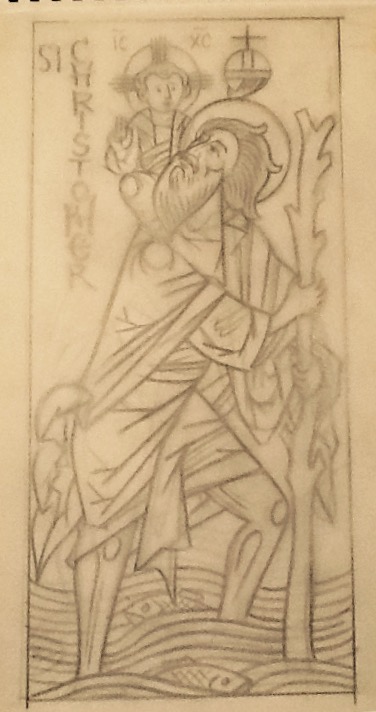
St.Christopher, Pray for Us!


This time of year and this year in particular, the whole world seems to be in motion.

The Holy Father sets out this week for Africa, where so many pilgrims even now are journeying to see him and pray with him.  Refugees and migrants in their tens and hundreds of thousands are on the move.  And in my own country, the airports and highways are filled with travelers headed home for Thanksgiving.

All this travel in a time of so much apprehension and fear and uncertainty.  The State Department issued a worldwide travel advisory for US citizens this afternoon and in France, Belgium and throughout Europe, Africa and the Middle East no-one knows when or where terrorists might/will strike again.

Living in the comparative isolation of Douglas, Alaska, I won't be leaving town for Thanksgiving.  But I've been thinking about travel and travelers the past few days as I've worked on the drawing for a relief print of St.Christopher, patron saint of travelers.  He is shown bearing the Christ-child across a river with a swift current.  Tradition says that the saint, who was a giant of a man, was bowed down the weight of the child, who was almost to heavy for him to bear.  When they reached the other side, he realized that he was bearing Christ, who bears the weight of the whole world.

In the Middle Ages St. Christopher's image was placed in churches and on street corners and stamped on medals in the devout confidence that travelers who looked on his image would arrive safely home.  After the Second Vatican Council, in a (seemingly) less credulous era, St. Christopher was (unfortunately) removed from the Roman Calendar because there was no conclusive evidence that an actual saint named Christopher ever lived.

Yet he remains quite popular.  Not surprising really, for who can fail to be attracted to a saint whose name means Christ-bearer.  Which isn't a bad description of Christian discipleship and the universal vocation to holiness (see Lumen Gentium).

Like Christopher, each of us helps to bear other Christs a little or a long way through the swift, sometimes raging currents of life in this uncertain, dangerous but grace-filled world.

Yet our lives, our days, this world, are, in every moment, borne by Him.  Who bears us, in life, in every danger and distress, even in death itself, safely home.

St. Christopher, pray for us!


Tuesday, November 10, 2015

Getting in Touch with My Inner Salieri

A friend and student of mine, who is herself a cloistered Carmelite sister kindly shared with me some of her thoughts on St. Therese (and the rough sketch of a pattern for her icon.)  I based the pattern I drew on her own completed icon of St.Therese, which she has graciously given me permission to shamelessly copy.  Besides saying that the drawing bore a passible resemblence to the actual Carmelite habit, and the gentle but firm suggestion that I lose the flowers in the background, she also shared some great insights into Therese herself.  

She sharted that she thinks the key ot understanding St. Therese is that she is the Mozart of the spiritual life - simple, direct, profound, but in the end, elusive.  And she noted that while Therese has grown on her, that as the oldest in her family, she found Therese, who was the youngest in the Martin family, less than sympathetic.  But she also wrote that as she has matured in the spiritual life, St.Therese has directed her to what is most essential, which is to rely, unreservedly, on the love and mercy of God.  

So thanks, Sister, for opening the door of my heart (if only just a bit more) to this elusive genius of the spiritual life.  


Sunday, November 8, 2015

Please Capture My Heart!

I've begun reading "Shirt of Flame:A Year with St.Therese of Lisieux" by Heather King.  Its an introduction to the life of St.Therese and her "Little Way" refracted through the life and experiences of the author, an ex-lawyer, recovering alcoholic, contemplative and Catholic convert at midlife.  I'm only a chapter past the introduction, but I'm hoping that this might provide me with the way into a deeper appreciation of this remarkable saint who is the patroness of our diocese here in Juneau and whose shrine north of town on Lynn Canal is a place of particular devotion to her.   And of course, because I read and pray better with a brush in my hand, I've also begun drawing the pattern for an icon of her.

Given all that, you'd think a devotion to St.Therese would come naturally to me.

Well, think again.  For reasons that I don't fully understand, I've never really warmed to St.Therese.  Not dislike or repugnance or disagreement -- but to date, she hasn't yet seized hold of my imagination or more importantly, captured my heart.  Which is necessary (at least for me!) to compose an icon that has any life or truth in it.  Yes, I understand that the icon, (which makes visible the person or salvation narrative invisibly present to the one coming before in prayer ) does not depend on the ability or temperment or even the understanding of the iconpainter.  But for me at least, grace has to build on nature, which in my case means that there has to be an inner resonance between the saint or the mystery which is the subject of the icon and my own spiritual vision and understanding.  That vision, however weak, fallible and limited, is, for all that, uniquely my own.

So as I begin to ponder what Heather King has to say about St.Therese (presented throughout the book in the words of her spiritual autobiography), I hope this holy young woman who dedicated herself to the Child Jesus and to the Holy Face, will indeed seize my imagination.  And that she will eventually capture my heart.