Showing posts with label gold leaf. Show all posts

Tuesday, October 18, 2022

Saint Luke, Pray for Us!


Today is the feast of St. Luke the Evangelist, the patron saint of artists and iconographers).  I love this particular icon of him painting the icon of Mary, the Mother of God and Jesus, who are posing for him. The the composition of this icon is based on a drawing by my master teacher, Pere Igor.  Unfortunately, I never had a chance to ask him why the pose of the two figures in the icon are so different from the actual figures who are standing in front of him.  

So on his feast I was able to make a bit more progress on highlighting the figure of the Mary and Jesus in the center of the triptych.  Her garment is highlighted in paint; the figure of the Christ Child is highlighted with gold leaf (sometimes called 'gold assist').  

His little overgarment is highlighted in much the same way as with paint, only using finer, sharper brush strokes.  Instead of paint, gold size (a crushable compound called a mordant that dries tacky) is applied to all of the areas where a gold line is desired.  It has to be thick enough so the brushstrokes will hold their shape and fluid enough to paint with.  

When the size has set (depending on the size it will remain open for at least an hour or two), gold leaf is then pressed onto the areas painted with size.  And voila! The gold lines appear as if by magic on the icon (usually) when the excess gold is gently brushed away with a soft brush.

Then follows the painstaking faulting of the gilded areas, because inevitably, their will be lines here and there that the gold did not adhere to or a line or two the one wielding the brush failed to paint in, and so the process is repeated once or twice (or again and again if you are having a particularly bad day) until all the gold lines are complete.

A couple of coats of shellac to fix the gold leaf (which is surprisingly fragile), followed by redrawing the lines as necessary to pull it all together.


Saturday, October 17, 2015

Why I Always Use Red Bole


It turns out that burnished water gilding, that is applying gold leaf to a bole ground and then polishing it with an agate (or a dog's tooth) burnisher until it shines, is actually easier than you'd think it would be.  The secret is to apply a thin coat of gilder's clay mixed with size to the gesso, sand and polish it, and apply the gold leaf.  Piece of cake --  sort of -- as long as everything goes exactly right.  But if the clay/glue ratio is off, or its too dry or too humid, or there is unusual solar flare activity, forget about it going as planned.

But lately I've been able to manage to get pretty good results gilding and burnishing haloes.  Not bad for 35 years of effort!  Pretty OK.   Not perfect-the gilding is NEVER perfect, there's inevitably a flaw, a fault, a thin spot or a pinhole if you look carefully enough, which why bole is usually red. (The red makes the faults disappear.)

Seems to me an apt, if homely metaphor for grace .  The color is wrong, of course -  it is our sins that are like scarlet, not grace, but isn't it grace that covers over our faults, failings and sins and makes them disappear?


Tuesday, August 27, 2013

No Other Remedy

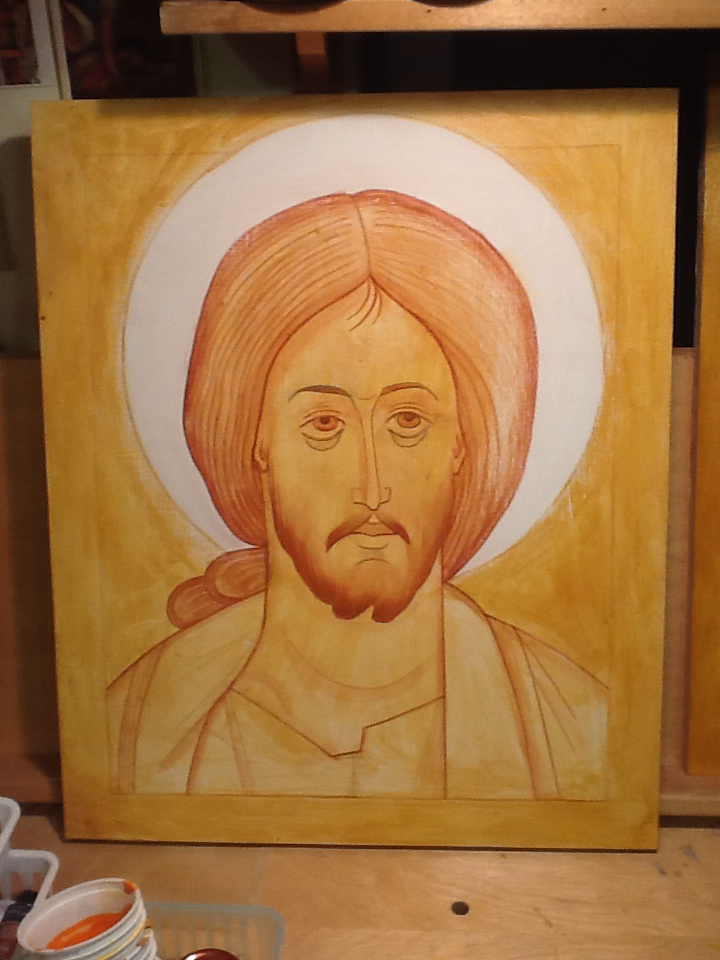
Of course, as I already knew yesterday, fortuna had really nothing to do with the setback I experienced with the halo of the icon of Christ. As is the case, inevitably, also in the spiritual life, it wasn't bad luck that was my problem but that I cut a few corners along the way.
So it was back to the basics. I ground the bole, first in water until it was smooth, then added the glue and ground it a second time.

I used a big brush --the biggest brush I could manage-- to float the bole on the icon. I don't know why exactly I held back earlier and applied it with a smaller brush, but I did and it made a difference. So the first layer of bole is back on the board and we'll see how it all turns out.
I keep a little collection of quotations by St.Teresa of Avila next to my prayer corner in the studio, open to this admonition of her's. It reminds me of my friend, the newly departed servant of God, Sr.Rosemary, who chose the quotations and designed each page with her friend Sr.Mary Grace at the Carmel of Terre Haute, Indiana.
When I look at her calligraphy I am reminded of her beautiful spirit. But I'm encouraged both by the words of St.Teresa and by my friend's example of perseverance in prayer and the hidden life of Carmel, not to give up on the 'one thing necessary', which is always communion with Christ in prayer.
My temptation in prayer which I readily admit to succumbing to more often than I like to admit, is to cut corners, to rush, to let my mind wander and then get so discouraged that I give up altogether.
So in the life of prayer, as in the work in the studio, there's no other remedy but begin again.


Wheel of Fortune

The ancients as well as medieval people never seemed to tire of meditating on the idea of the "rota fortunae" literally, the "wheel of fortune" as a reminder of the transitory nature of worldly success. Fate or luck, personified as the goddess Fortuna, was depicted turning the crank on a large wheel. Seated on the wheel were various people either ascending to the top of the wheel or descending to the bottom.
In our example of the "Rota Fortunae", (courtesy of aclerkofoxford@blogspot.com) a regal looking fellow wearing a crown is seated at the top. He is holding the symbols of earthy power. But his crowned companion to is right is already headed downward, his neighbor has lost his crown and his regal attire and the poor unfortunate on the bottom is falling off the wheel entirely!

But to his left, clinging to the wheel with all his might, another man is being slowly raised up and the man ahead of him reaches for the prize.

I too managed to take a ride this evening on the "Rota Fortunae" . Of course, my turn on the wheel involved (what else?) gilding. The wheel started turning as I began carefully applying gold leaf to the bole of the halo of the icon of Christ that I have been hard at work on for the past couple of days.

After over an hour of painstaking work, I applied the final piece of gold leaf. There I was, the fellow reaching expectantly for the crown and orb, which appeared to be just within reach. After waiting for the requisite length of time , I began gently burnishing the gilding. That was when Bella Fortuna gave the wheel a turn -- the halo wouldn't burnish! And then she gave it another turn -- each stroke of the burnisher was scraping off the gold leaf!

Something, it soon became evident, was wrong with the bole, which meant that it had to come off. All of it, which involved soaking the bole, scraping it all away and then cleaning off the muddy red clay mess smeared on the icon.

In the end not too much the worse for wear.

So I'm ready to climb back on the wheel. I plan on hanging on tight and hoping that I'm on the upswing as I get ready to gild that halo again.

Is it my imagination, or does Fortuna have a slight smile? And isn't she supposed to be blindfolded?

Tuesday, August 20, 2013

Ora et Labora (continued)

Today and yesterday were all about gilding and prayer. Yesterday I applied gold leaf to the haloes of the icon of the Mother of God and Jesus which I am working on.
The red bole on the halo is a mixture of clay and glue. First, I breathe on the bole. The warmth and moisture of my breath makes the bole become sticky for just a few moments (perhaps 10-15 seconds).


Then I quickly press the gold leaf onto the bole and gently rub on the back of the paper that the gold is attached to.
It's a time consuming process, because in order to be able to burnish (or polish) the gold leaf, I have to gild the halo not once but twice.
It took me most of yesterday to gild the haloes and then to begin burnishing them.


Burnishing the gold also takes time - there is no rushing the process. If everything goes right, burnishing is simplicity itself. Using an agate burnisher (a completely smooth agate set in a wooden handle), you rub the gilded surface with the agate until it begins to shine. Piece of cake! Unless something goes wrong. Which always seems to happen. There may be tiny holes in the gilding or the burnisher lifts up some of the gold or there is one spot that just doesn't want to shine, no matter how much you burnish it. Which usually means making corrections (faulting) to the gilding. but in the end it is worth it.

These last few days have also been a time of prayer. I'm grateful that my studio is also my oratory.

My urgent prayer of supplication has been for Egyptian Muslims and Christians in the aftermath of the coup that toppled the government of Muhammed Morsi, the leader of the Muslim Brotherhood who was elected President of the country a year ago. This has led to demonstrations against the new government by Morsi supporters, demonstrations that that army and security forces have fired upon, killing hundreds of protesters in at least four separate incidents that can only be charactorized as massacres.

In addition to violence between pro and anti-Morsi rioters in various Egyptian cities and towns, extremist elements in the Muslim community appear to be scape-goating the Christian minority around the country and mobs have looted and burned over 60 churches and church related buildings in the past week.
Praying evening prayer tonight was for the feast of St.Bernard of Clairvaux, the great eleventh century reformer and Doctor of the Church (called the Doctor mellifluus, the Honey-sweet Doctor for his love of the word of God and devotion to the Blessed Virgin Mary) yet preached the catastrophic Second Crusade.
The reading, from the Letter of St. James, gives me much to ponder.
"Wisdom from above is first of all innocent. It is also peaceable, lenient, docile, rich in sympathy and the kindly deeds that are its fruits, impartial and sincere. The harvest of justice is sown in peace for those who cultivate peace."
May it be so, in our hearts and in the hearts of our brothers and sisters in Egypt.