Friday, July 7, 2017

Who Are These Children Dressed in White


 "Who are these children dressed in white?  They must be the children of the Israelites." 

As I ponder the estimated ten thousand migrants and refugees rescued last week from the Mediterranean, I keep coming back to the story of the Exodus, as these many peoples risk their lives to be delivered from the bondage of war, persecution, famine and poverty, with Pharoah in hot pursuit and the water blocking their way.

Middle Easterners, South Asians and Africans, Muslims and Christians are all mixed together in the millions of refugees and  migrants whose exodus is unfolding daily before our eyes.  So taking my cue from the words of the African-American spiritual, "Wade in the Water", at least for this stage of this icon, I have depicted the refugees and migrants dressed in white.  

Let us continue to pray for them, that through the intercession of Mary, Mother of Refugees and Migrants, all of her children may find deliverance and safety, especially those in peril on the sea.

Friday, June 30, 2017

Mary, Mother of Mercy, Pray for Them!


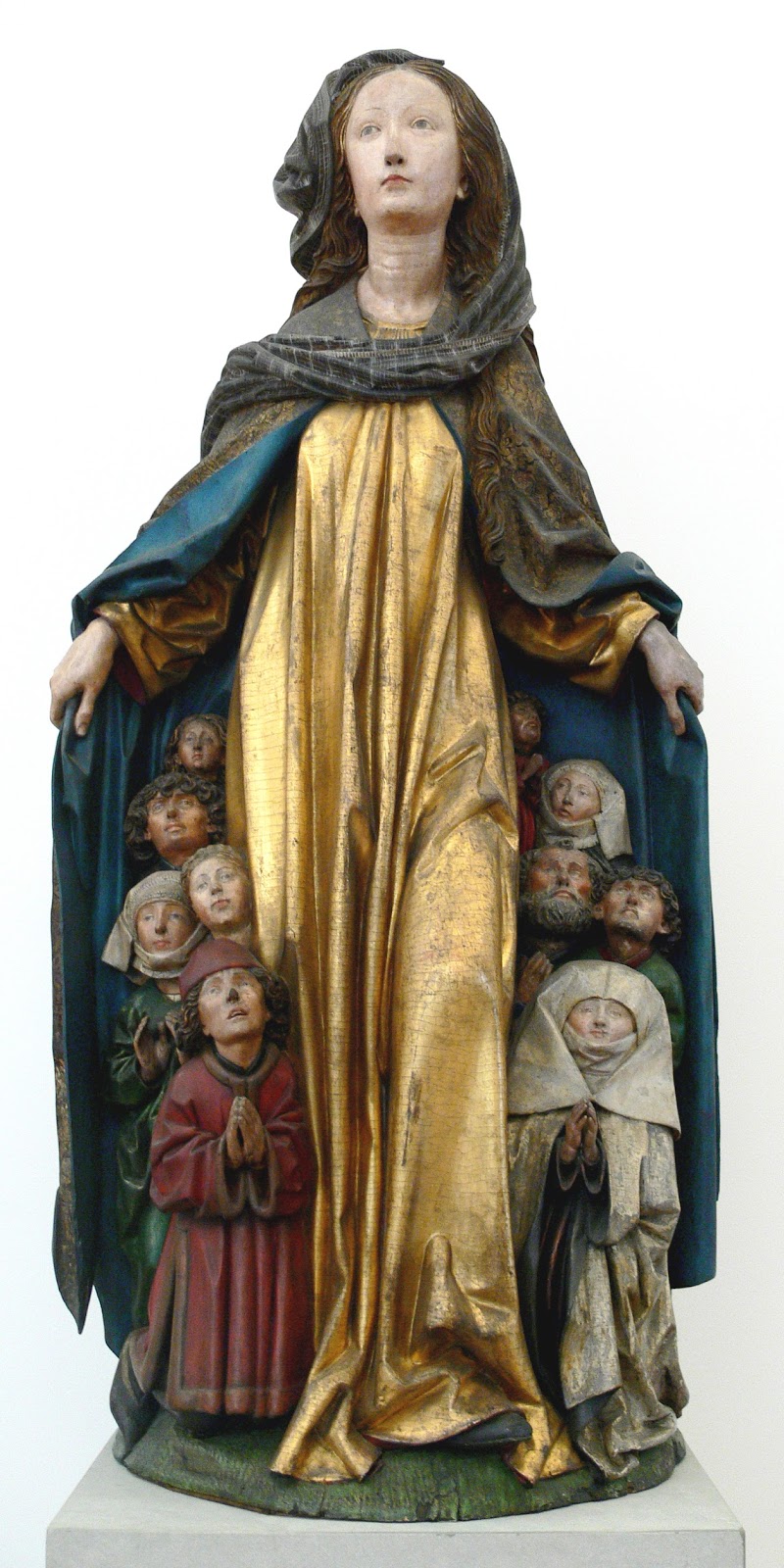
Ravensburger Schultzmantel Madonna
I'm beginning my fourth and final week teaching in the studio (and on retreat) while taking annual leave from my regular job at the Diocese of Juneau.  It is always a welcome opportunity to quiet down, reflect and pray.   I've been particularly praying for  refugees,(who are fleeing either political or sectarian violence and war) and migrants, who are trying to escape poverty, drought, crop failure and famine.

Its hard for me to understand the difference.  On one side of my family, my Alsatian ancestors were refugees, forced out of Alsace after the German defeat of France in 1870.   My Irish immigrant economic migrants, trying to survive the very real threat of starvation during the Great Hunger and hoping for a better life.  Both families made the perilous journey by sea to America and found asylum  (if not, in the case of the Irish, welcome) in the New World.

This past week, more than 20,000 migrants from Africa and Asia were rescued attempting to cross from North Africa to Europe without authorization (legal immigration is closed.  They are desperate and vulnerable and the traffickers who prey on them are unscrupulous and greedy, packing them by the thousands in unseaworthy ships and  rubber rafts.  Over 5,000 drowned in 2016 and 1,985 to date in 2017 when their boats were swamped or capsized.

It is a humanitarian and human tragedy that will only get worse, in a world in which 65.3 million people are refugees.

As I've noted in earlier posts, I pray better with a pencil or a brush in my hand, and as I was praying for those desperate people in peril in the Mediterranean and those rescuing them, the image of Mary the Mother of Mercy came into my mind.  Made popular by the mendicant orders such as the Franciscans and the Dominicans, the Mother of Mercy is depicted extending her cloak over those seeking her protection and prayers.  There are many, many variations.  The Ravensburger Schultzmantel Madonna is a well-known example.
>
And thus, this initial drawing for an icon of Mary, Mother of Mercy, Mother of Refugees and Migrants.  


Mary, Mother of Mercy, extend your protective mantle over refugees and migrants everywhere, especially those in peril on the sea!

Friday, June 16, 2017

A Month Away on Retreat (Without Leaving the City Limits)


I'm taking annual leave for four weeks to work in the studio with a student, Julie Perigo, who has come to Juneau for an intensive tutorial on icon painting.  We've already completed almost a week together and she has begun work on the Holy Face ('The Icon of Christ-Made-Without-Hands)


This icon is best starting point to introduce the theology of the icon and the spirituality of the iconographer and a good place to begin painting as well, as the composition is very simple.


She is also getting hands-on experience (no pun intended) in the craft work of making wooden icon panels and preparing the levkas (the gesso ground for the board) as well as water gilding and egg tempera painting.

I'm grateful to have the leave time to devote to working with her and being in the studio.  It is as much a spiritual retreat as work time, as I tend to pray best with a brush (or a piece of sandpaper) in my hand.

Friday, May 26, 2017

What A Gift

 In Southeast Alaska where I live, the landscape is overwhelming in size and scale.  Endless vistas of mountains, forests, water and clouds.  
Yesterday, while watching a whale (another enormous creature in every respect) while it was feeding offshore, I was given the more intimate experience of seeing a fawn on the beach.  It was crouched motionless in the rocks.  Its mother had been startled by some people walking the beach and had run off.  The fawn instinctively froze,waiting for its mother to return for it.  What a gift to be close, even for a few moments, to such a beautiful, wild creature, in such a place and in such a setting! 

Friday, May 12, 2017

Steadfast Love


Our celebration of the memorial of St. Damian de Veuster (Damian the Leper) on May 10th is a reminder of what steadfast love looks like.  Fr. Damian, a Belgian priest, dedicated his life to those suffering from leprosy who were confined to the leprosarium on the Hawaiian island of Molokai.  He gave himself completely to the lepers, and after contracting leprosy (Hansen's disease), died among them and was buried with them.

I was reminded of the steadfast love of another generous and compassionate man, Dr. Janusz Korczak (Dr. Henryk Goldszmit), a Polish Jewish pediatrician, children's author and humanitarian.  He was a man of many gifts and talents.  A skilled and compassionate pediatrician,  he established just before the outbreak of World War I a Jewish children's orphanage, Dom Sierot in Warsaw.  As the director he implemented the principles of what was then called the New Education movement, which proposed a holistic pedagogy that took into account the moral, spiritual, physical and intellectual development of the child.

He wrote: "...children should be fully understood... must be respected and loved, treated as partners and friends... [and that] one ought to behave towards [each child as] a respected, thinking and feeling human being." Under the pen name Janusz Korczak, he wrote children's books that illustrated the challenges faced by the impoverished children who were in his care.

During the Nazi occupation of Poland, Dr. Korczak accompanied the children and staff of his orphanage into the Warsaw ghetto, rejecting generous offers by rescuers to bring him to safety.  He refused to be separated from the children of the orphanage and walked with them to the terrifying Umschlagplatz, where the Jews of Warsaw were assembled for deportation.  On August 7th, 1942, Dr. Korczak, with 190 orphan children in his care were killed at the Treblinka death camp.

A teacher who studied under his direction wrote:
"Everyone makes so much of Korczak's last decision to go with the children to the train.  But his whole life was made up of moral decisions.  The decision to become a children's doctor.  The decision to give up a full-time medical practice and writing career to take care of poor orphans, The decision to go with the Jewish orphans to the ghetto.  As for that last decision to go with the children to Treblinka, it was part of his nature.  It was who he was.  He wouldn't understand why we are making so much of it today."


Monday, May 8, 2017

My Privilege Is To Have No Privilege


My Privilege Is To Have No Privilege


The sign of how much I love God is how much I love those I love the least.

Dorothy Day


even in heaven
hers was a minority viewpoint

she knew her Aquinas --
that to contemplate
the just punishment of the wicked
adds to the joy of the blessed

not her idea of paradise.

so without fanfare
Dorothy Day
took up residence in the infernal regions
rented a rundown storefront
taped a sign in the broken window
'House of Hospitality'.

she walked a daily picket line
protesting stiffling heat  
insatiable thirst  bad working conditions  
eternal torment

passed out copies
of her penny-newspaper
to any of the demon-harried 
who would take one

worked the soup-line
poured endless cups of coffee
scrounged cookies and day-old donuts
from a sympathetic archangel
listened patiently
to the piteous complaints
of the damned

she was last seen
at suppertime
hunched over a table
showing a weeping dictator
photos of his grandchildren.


Monday, May 1, 2017

St. Joseph the Worker, Pray for Us


Today is May Day and in the Catholic calendar the memorial of St. Joseph the Worker.
On this day, I remember with gratitude my former pastor, Fr. Donald McDonnell of Our Lady of Guadalupe parish in San Francisco and the life and work of Cesar Chavez (1927-1993), who Fr. McDonnell helped inspire Chavez to found the United Farm Worker's union.


Fr. Donald McDonnell
It was Fr. McDonnell , while pastor of Our Lady of Guadalupe parish in San Jose, who introduced Chavez to Catholic social teaching and who encouraged him to get involved in labor organizing.  Fr. McDonnell, as one of the "Mission Band" of priests who ministered during the 1950's to the largely Hispanic and Filipino migrant workers in California's Central Valley, had been exposed to the low wages, back-breaking labor and dehumanizing working conditions that were the day-to-day experience of farm workers.

Cesar Chavez

Chavez went on (with fellow labor organizer Dolores Huerta) to found the United Farm Workers union, which eventually, after years of struggle with growers that involved non-violent civil disobedience, fasts and hunger strikes and national boycotts of agricultural products such as grapes and lettuce, was able to organize and represent agricultural workers.

The feast today of St. Joseph the Worker is a needed reminder of both the dignity of work and the human dignity and rights of workers.

As Pope St. John Paul II, stated forcefully in 1984 :
"The needs of the poor take priority over the desires of the rich; the rights of workers over the maximization of profits; the preservation of the environment over uncontrolled industrial expansion;
and production to meet social needs over production for military purposes."

Catholic social teaching, which Fr. McDonnell introduced a young Cesar Chavez to over sixty years ago, upholds the right of workers to organize, to be represented by trade unions, to safe and decent working conditions and to a fair and living wage.  The US Catholic bishops, in their 1983 pastoral letter, "Economic Justice for All" articulated ten principles related to economic justice and the rights of workers.  http://www.usccb.org/issues-and-action/human-life-and-dignity/economic-justice-economy/catholic-framework-for-economic-life.cfm  They are as valid and imperative today as they were almost thirty-five years ago.


On this day on which we commemorate workers and St. Joseph the Worker, may we find inspiration and hope in the United Farmworker's Prayer which Chavez wrote:

Show me the sufferings of the most miserable, so I may know my people's plight.
Free me to pray for others, for you are present in every person.
Help me to take responsibility for my own life, so that I can be free at last.
Grant me courage to serve others, for in service there is true life.
Give me honesty and patience, so that I can work with other workers.
Bring forth song and celebration, so that the Spirit will be alive among us.
Let us remember those who have died for justice, for they have given us life.
Help us love even those who hate us, so we can change the world.
Amen.